
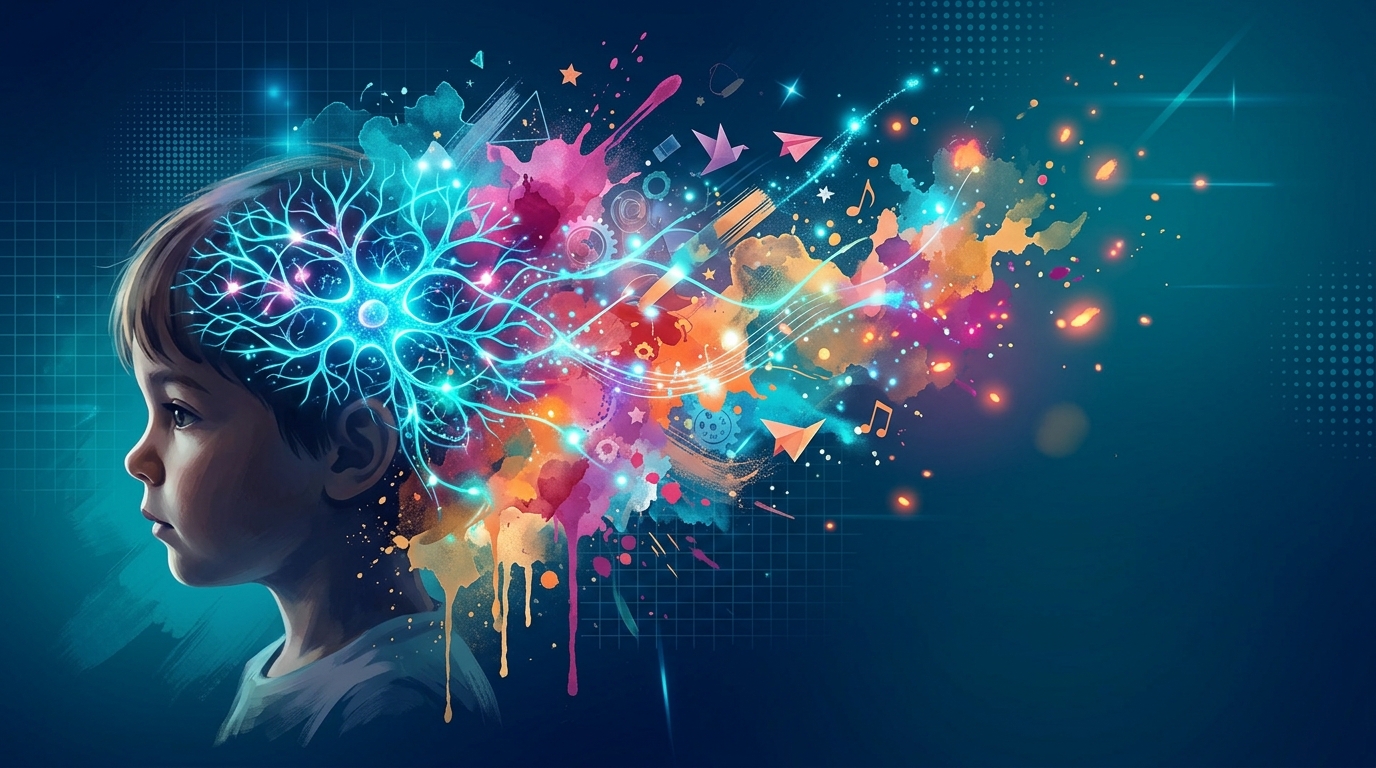
Divergent thinking and artistic expression are part of the daily lives of many children and young people. They are used to explore ideas, communicate emotions, learn, and connect with their surroundings from unique perspectives. However, their direct impact on cognitive development and neuroplasticity continues to be the subject of profound academic and neuroscientific research.
Studies from the Harvard Graduate School of Education point out that arts education and visual culture can have significantly positive effects on the brain structure of children and adolescents. On one hand, they facilitate the connection between both brain hemispheres, allow students to process complex information flexibly, and help them develop a greater tolerance for ambiguity. In fact, research cited by Harvard shows that many children who actively participate in creative activities improve their ability to solve unstructured problems.
At the same time, the lack of artistic stimuli and overexposure to purely repetitive tasks can limit the development of critical thinking and innovation. Harvard notes that the absence of spaces for free exploration is often associated with cognitive rigidity behaviors and lower adaptability to changing scenarios. However, it is important to highlight that creativity is not an innate and immutable talent, but rather a dynamic skill that is strengthened through constant practice.
For this reason, rather than considering art simply as a hobby, it is essential to observe how, how much, and with what intentionality creative expression is encouraged in each young person.
The development of divergent thinking is one of the aspects that deserves special attention. Cultural experiences, visual design, and hands-on creation allow students to connect seemingly unrelated concepts, transforming the way they interpret and respond to their environment.
Education experts recommend establishing creative routines, creating moments of exploration without judging the results, fostering curiosity about diverse cultural manifestations, and, especially, having adults accompany and value creative processes over the final product.
The goal should not only be to train professional artists. It is also fundamental to help young people develop their own criteria to innovate, express what they feel, and find original solutions to day-to-day challenges.
The development of creativity is part of holistic development. Just as we teach children to take care of their physical health and logical reasoning, we can also teach them to build a solid and enriching relationship with art and culture.
For INTANGY, this represents a key opportunity to strengthen the creative skills that allow children and adolescents to thrive in a dynamic world, without losing sight of their authenticity, their capacity for innovation, and their personal development.
Keep reading
/// Next step
Discover your child's talent
30 minutes online with an INTANGY specialist, free of charge.